Product News
Index > NEWS > Product News
Breaking the Deadlock of the "Dark Swarm"
Breaking the Deadlock of the "Dark Swarm"
— How Infrared Laser Tears Open the "First Death Window" of Anti-UAV Systems
Introduction
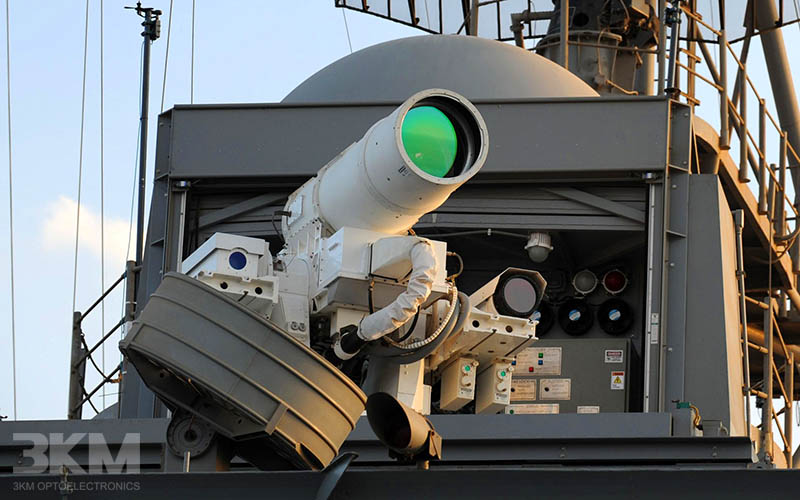
As "low, slow, and small" UAVs evolve into precision-guided "loitering munitions," modern battlefield air defense networks face unprecedented pressure. In particular, micro-sized targets such as FPV drones, with their extremely low Radar Cross-Section (RCS), high maneuverability, and swarm tactics, are rewriting the rules of warfare. For laser hard-kill anti-UAV systems, the real challenge lies not in the moment of destruction, but in a critical and often overlooked threshold—identification range.
Identification is the starting point of every kill chain. Without the ability to accurately confirm and lock onto a target within an effective range, even the most powerful laser weapon is merely a "blind giant." This article delves into the real-world pain points of anti-UAV systems and reveals how a key enabling technology—infrared laser active illumination—serves as the decisive blade that tears through the night and locks onto the target.
I. The Fatal Flaw of Anti-UAV Systems: A Compressed "Identification Window"
Before exploring solutions, we must clearly recognize the severe challenges currently facing anti-UAV systems.

1. The "Stealth" Dilemma Posed by Target Characteristics
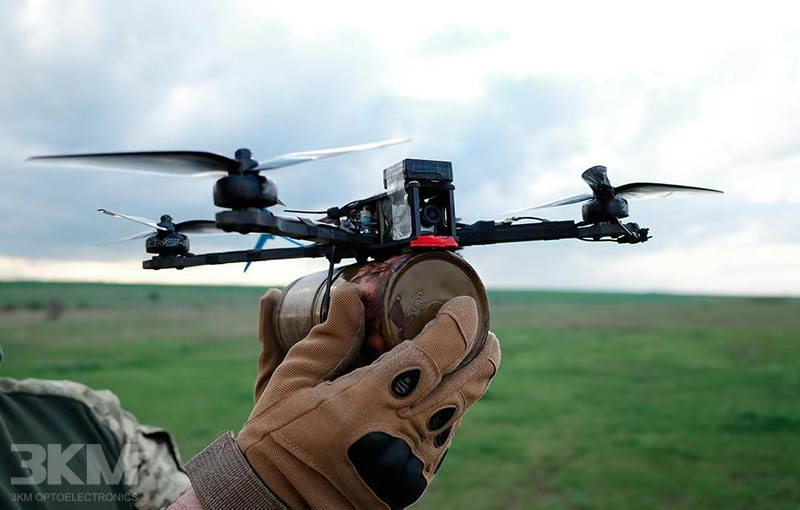
Modern FPV drones, especially 5-inch class models, are built for attrition. They extensively use carbon fiber, engineering plastics, and other non-metallic materials, with RCS as low as 0.001 m²—appearing on radar screens no different from a bird. This means that even if traditional radar can detect such targets, effective identification of friend or foe is often impossible.
2. The "Visual" Cliff at Night and in Complex Weather
Electro-optical systems are the primary means of target identification, but their effectiveness plummets sharply at night or in adverse weather. Although thermal imaging works around the clock, its effective identification range for 5-inch FPV drones—which have few heat sources and small surface areas—is often compressed to 700–900 meters. However, the effective engagement window for laser weapons typically opens from 1,200 meters or more. This creates a dangerous "gray zone": the laser can reach, but the eyes cannot see clearly.
3. The Throat Gripped by "Time" — The 10-Second Death Window
Take a 10–30 kW laser system engaging an FPV drone traveling at 22–56 m/s. A physical engagement window of about 21 seconds is available, but the truly effective window for identification and strike may be only 10 seconds.
Within these precious 10 seconds, the system must complete target acquisition, turret slew, precise tracking, identification confirmation, range-finding, parameter calculation, and laser firing. The time left for "identification and confirmation" is extremely limited. Furthermore, due to radar guidance errors, target evasive maneuvers, and system slewing inaccuracies, a single failed acquisition followed by a re-identification process can consume several critical seconds.
If reliable identification is not achieved before a 5-inch FPV drone crosses the 1,000-meter irreversible attack threshold, the entire interception mission fails. Therefore, whoever can secure more distance margin and faster response within this "identification window" will seize the battlefield initiative.
II. The Path to Breakthrough: How Infrared Laser Reshapes the "Identification Distance" Advantage
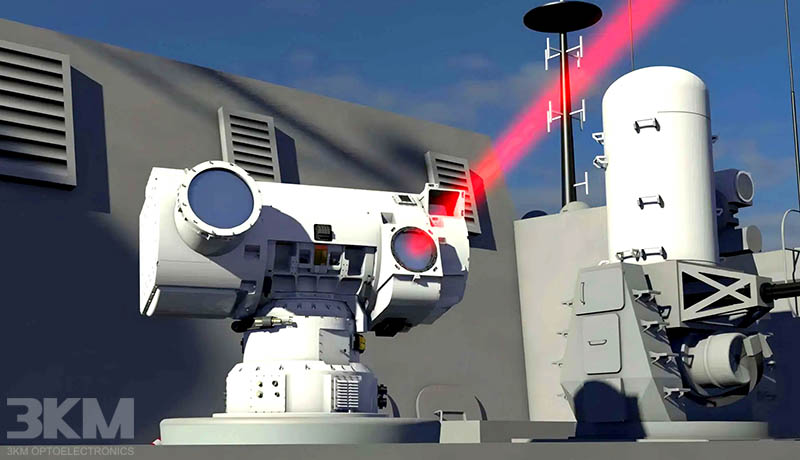
Confronted with the above pain points, traditional passive detection methods fall short. At this juncture, infrared laser active illumination technology, combined with high-sensitivity low-light cameras, becomes the key to breaking the deadlock. Rather than passively waiting for target radiation signals, it actively "lights up" the target, turning night into day.
1. A Hard Metric Breakthrough: Turning Night into Day
The core value of an infrared laser illuminator system lies in granting low-light cameras an identification distance comparable to daylight. Based on real-world test data for 5-inch FPV drones:
• Thermal imaging identification range: Only 0.7–0.9 km.
• Infrared laser-assisted identification range: Up to 1.2 km or more.
This means infrared laser pushes the system's reliable identification distance forward by 300–500 meters, precisely at the forefront of the laser hard-kill's most critical "firing window." The extended identification distance provides two major advantages: first, it buys additional time for AI algorithms to analyze and assess; second, it reserves opportunity for re-identification in response to target maneuvers or system errors, while also allowing more time to address multiple UAVs in a swarm.
Notably, this technology yields even more pronounced results for slightly larger targets: the identification range reaches 1.4 km for 7-inch FPV and 1.7 km for 10-inch FPV.
2. Piercing Battlefield Smoke: The "Fiery Eyes" of 1550nm
Real combat environments are filled with smoke, fog, haze, and battlefield dust—natural enemies of traditional laser weapons. However, not all infrared wavelengths are created equal.
A rigorous smoke penetration test illustrates this vividly: under extreme conditions of a 50-meter test distance and 5-meter-thick dense smoke:
• 808nm and 940nm infrared lasers: completely unable to penetrate the smoke, with targets fully obscured.
• 1550nm infrared laser: easily penetrates the smoke, rendering objects and text behind the smoke clearly visible.
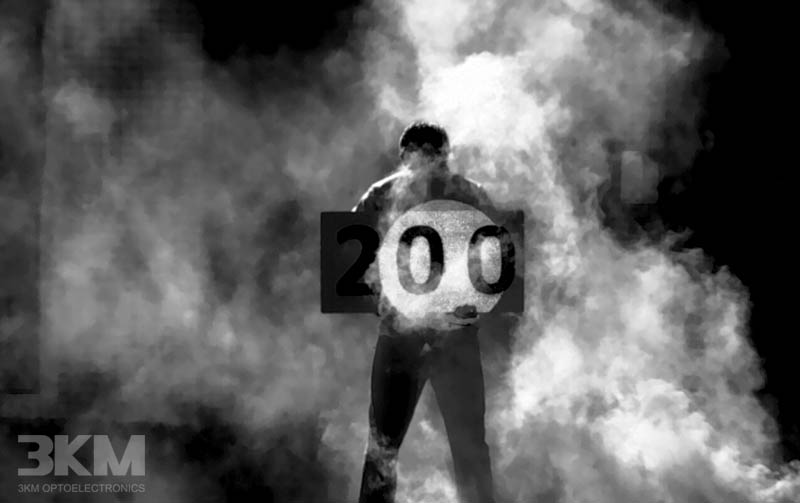
This test result carries decisive practical significance. Compared to the more common 808nm or 940nm near-infrared wavelengths, the 1550nm wavelength lies within an atmospheric transmission window, exhibiting far lower scattering and absorption effects in smoke, rain, fog, and haze. This means that when other electro-optical sensors are "blinded" by battlefield smoke, the 1550nm infrared laser illuminator can still provide the camera with clear target reflection signals, ensuring the integrity of the identification link.
3. Breaking the Fatal Flaw of Thermal Imaging
Although thermal imaging is widely used, it suffers from two inherent and critical shortcomings:
• Susceptibility to heat source interference: Environmental temperature differences, ground heat, and other thermal sources can severely disrupt thermal imaging identification.
• Blurriness for low-thermal targets: FPV drones extensively employ thermal insulation materials, with heat signals only coming from four small motors and a lithium battery. The thermal spots are small and the signatures are indistinct.
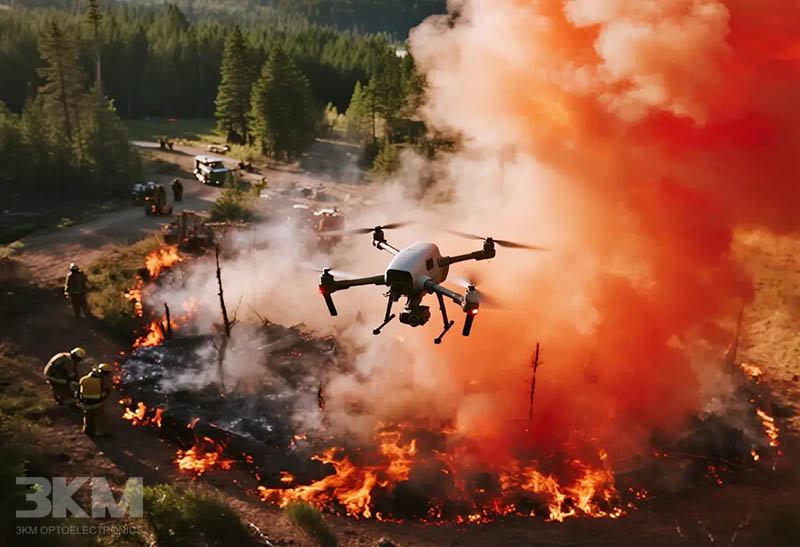
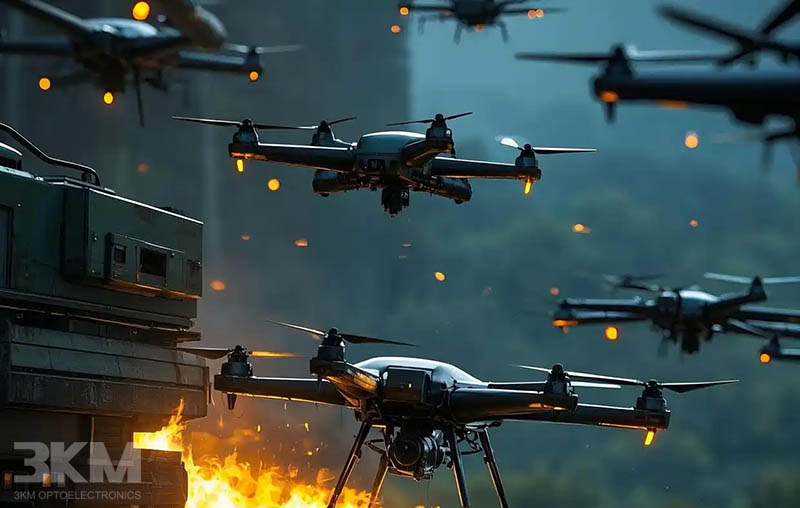
It is especially worth emphasizing that in real engagement scenarios, thermal imaging is severely affected by dense smoke, hot debris, and flames on the battlefield—explosion-induced fire, burning wreckage, and spreading smoke generate numerous false hotspots and obscuration zones in thermal images, significantly increasing the likelihood of misjudgment and prolonging decision time for operators or AI algorithms. Within the critical 10-second identification window, such interference can prove fatal.
In contrast, infrared laser active illumination relies on reflection imaging based on target contours. It does not depend on the target's own heat emission and is immune to interference from battlefield flames and hot debris. When identifying low-thermal-signature FPV drones, the infrared laser identification range can be 2–3 times that of thermal imaging. This characteristic makes it the optimal solution for ensuring reliable identification under complex electromagnetic environments, thermal backgrounds, and smoke/fire-filled combat conditions.
4. Outstanding Cost-Effectiveness and Deployment Advantages
From a system cost perspective, infrared laser illuminator systems are significantly less expensive than higher-resolution, larger-aperture thermal imaging cores for the same identification distance requirements. This means that existing anti-UAV systems can achieve night combat capability upgrades at a lower cost.
III. Practical Application: Turning Technical Superiority into Decisive Advantage — Infrared Laser Illuminator Operational Tips
Possessing advanced hardware is only the first step. Fully leveraging its effectiveness in actual combat tests the system integrator's capabilities. Below are two practical operational tips for infrared laser illuminators.
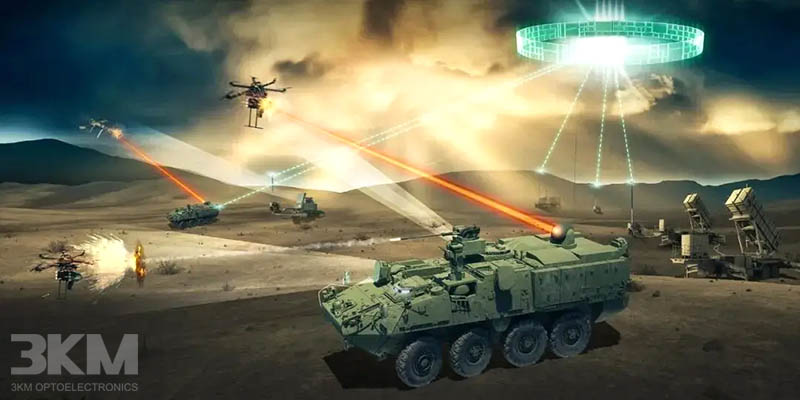
Tip 1: Zero-Delay Slewing — Countering "Instant Kill" with "Light Speed"
Infrared laser illuminators typically support zoom functionality. For a 2 km illuminator, the beam angle ranges from approximately 70° to 0.8°, with a full zoom cycle taking about 3 seconds.
Pain point analysis: Within a 10-second identification window, a 3-second response time is prohibitively expensive.
Solution: Given that anti-UAV system radar can localize targets beyond 5 km and effective identification typically occurs around 2 km, a practical strategy is to keep the infrared laser illuminator at its minimum angle by default (0.8°, beam diameter 28 meters) , concentrating the beam energy. When the radar directs the turret to slew, the laser beam instantly points to the target area alongside the turret, reducing physical response time to zero. This approach saves the precious 3 seconds otherwise spent on zooming, buying valuable time for subsequent acquisition and identification.
Tip 2: Elevating the Game — The "Dimensional Reduction" Advantage of Longer-Range Illuminators
Instead of limiting to conventional 2 km illuminators, consider deploying high-power laser illuminators with a 5 km illumination range. Such a unit features an angle adjustment range of 30° to 0.3°.
• Expanding the "visible cross-section": At 2,000 meters, if the 5 km illuminator's angle is set to 2°, the beam diameter reaches approximately 70 meters. This covers an area 3 times larger than the 2 km illuminator at the same distance and equivalent optical power density, effectively compensating for radar guidance errors and target maneuvers, ensuring the target remains within the illuminated zone, significantly improving the first-acquisition success rate and enhancing identification efficiency for swarm scenarios.
• Increasing "energy density": If the 5 km illuminator's angle is set to 0.8°, at 2,000 meters its beam energy density becomes 4 times that of the 2 km illuminator (0.8°, 28-meter beam diameter). Higher energy density translates to stronger return signals, significantly improving camera identification performance under low-contrast or smoke/haze conditions, reducing algorithmic recognition time, and extending effective identification range—all of which buy precious seconds for the laser strike.
Conclusion: Let Every Ray of Light Pave the Way for Destruction
In anti-UAV operations, "seeing clearly" is the prerequisite to "destroying". Infrared laser active illumination technology, by extending nighttime identification range, piercing through battlefield smoke and fire, and overcoming the inherent limitations of thermal imaging, equips laser hard-kill systems with a pair of "fiery eyes" capable of tearing through darkness and smoke barriers.
It not only completes the most critical link in the "detection–identification–tracking–engagement" kill chain, but also, with empirically verified 1550nm ultra-strong penetration and outstanding cost-effectiveness, provides a robust and reliable technological foundation for countering the increasingly severe threat of UAV swarms.
Among the seven core operational stages of an anti-UAV system, four can be completed within 0.2–1 second. Every additional meter of identification distance grants defenders one extra second of reaction time; every fraction of a second faster system response increases interception odds. Infrared laser is precisely the technology born to bestow this invaluable "time privilege" upon anti-UAV systems.


