Product News
Index > NEWS > Product News
One IR Surveillance System That Sees Through Mainstream Window Films Worldwide
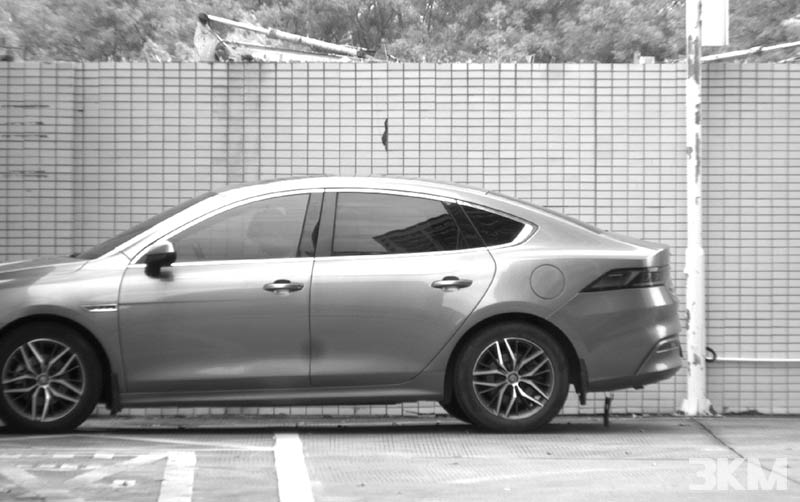
Real-World Test: Through-Tinted-Window (Heat-Rejection Film) Surveillance in Sunlight
Don't Fight the Film Head-On: One Infrared Surveillance System That Sees Through Mainstream Window Films Worldwide
I. A Reality That Gives Law Enforcement a Headache: Why Infrared Surveillance Always Feels Like "Opening a Blind Box"
In the field of law enforcement surveillance, observing conditions inside a vehicle from outside—whether the driver is using a phone, whether there is abnormal behavior—is a high-frequency, mission-critical task. An infrared laser surveillance system, consisting of an infrared laser illuminator paired with an infrared camera, should be the ideal tool for this job. It is covert, works in low light, and theoretically can penetrate car window glass to see details inside.
But reality is far crueler than theory.
In actual deployment, law enforcement agencies have found that even with a high-end configuration—a 1550nm infrared laser illuminator paired with a short-wave infrared camera, a "top-tier solution" that was highly anticipated—surveillance results remain extremely unstable. The same equipment, facing different vehicles, can produce wildly different imaging results: some cars can be seen through, others are completely opaque; some images are clear, others are too blurry to identify. As frontline personnel put it, every surveillance operation feels like "opening a blind box."
What's more troublesome is that for shade-plus-heat-rejection films, this high-end solution almost completely fails—it simply cannot see objects inside the vehicle, let alone details.
This is not because the equipment isn't good enough. It's because the direction is wrong. To understand why, we must first see the real face of the "opponent"—car window film.
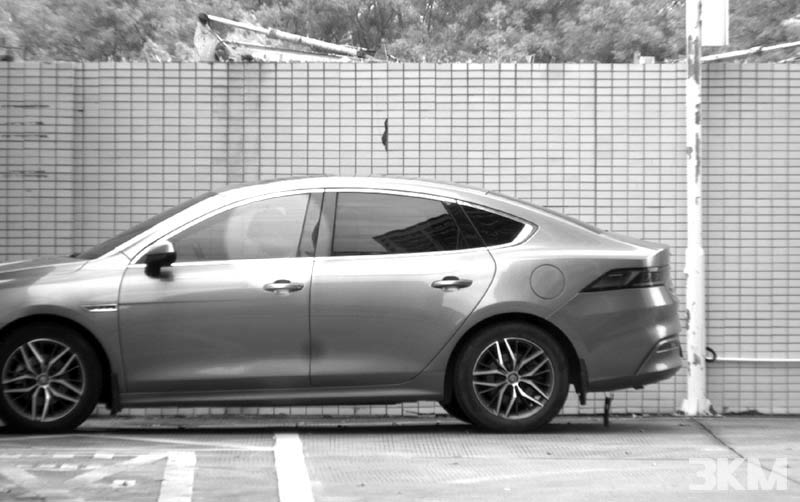
Side Front Window (Heat-Rejection Film) Penetration Effect
II. Three Major Pain Points: How Window Film "Blinds" Infrared Surveillance
The difficulty of through-window surveillance can be summed up in three progressively deeper pain points.
Pain Point 1: Reflected Light Interference—Glass Becomes a Mirror
Once window glass is filmed, surface reflectivity increases significantly. Ambient light, infrared illumination, and even headlights from oncoming vehicles all form reflections on the glass surface that enter the surveillance lens directly. The result is a washed-out image, collapsed contrast, and interior details "drowned" by reflected light. It's like taking a photo through a window at night—the flash bounces straight back off the glass, and nothing can be captured.
Pain Point 2: Light Absorption—Infrared Light Enters a "Black Hole"
Different films vary enormously in their ability to absorb infrared light. Nano-ceramic films specifically absorb infrared light at 900–1100nm, while magnetron-sputtered metal films reflect infrared light. Whether absorbed or reflected, the result is the same: the infrared illumination energy reaching the vehicle interior is severely attenuated. The light reflected back from targets inside the car is already weak; after passing through another layer of film "filtering," the signal reaching the camera sensor is almost nothing.
Pain Point 3: Too Many Types of Film—One Wavelength Can't Beat All Films
This is the most fundamental pain point. The car film market has four main technical routes:
Dyed film: Absorbs light but not heat; worst heat rejection; low price; gradually being phased out.
Ordinary metal film: Reflects part of the heat, but struggles to balance light transmission and heat rejection, and interferes with signals. Market share about 35%, demand shrinking.
Nano-ceramic film: Visible light transmittance 70%–85%, absorbs and blocks infrared light (mainly in the 900–1100nm range), good heat rejection without signal interference. Market share nearly 50%, demand growing.
Magnetron-sputtered metal film: Visible light transmittance 70%–80%, selectively reflects infrared light; the longer the wavelength, the better the blocking effect; 1550nm infrared reflectance can reach up to 98%. Combines light transmission and heat rejection, but slightly interferes with signals. Price is 1–3 times higher than nano-ceramic film; market share about 10%, mainly for the high-end market.
A single-wavelength infrared laser cannot simultaneously handle these four films with completely different principles. 808nm light may penetrate one type of film but be powerless against another; metal film has extremely high reflectance for 1550nm infrared, while other wavelengths of infrared are absorbed almost entirely by ceramic film. Surveillance results vary by film, by vehicle, and are completely unpredictable.
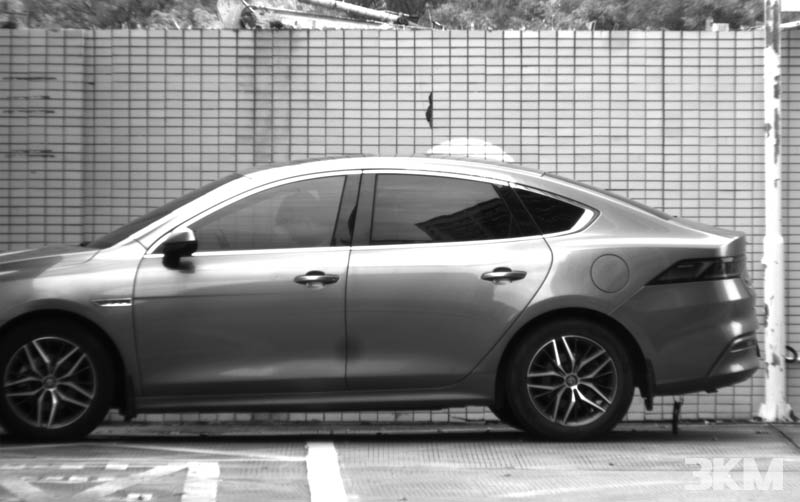
Side Rear Window (Dark Heat-Rejection Film) Is Harder to Penetrate Than Side Front Window
III. The Root of the Technical Bottleneck: Using a "Spear" Against a "Shield" Guarantees Mutual Destruction
From a technical standpoint, a 1550nm infrared laser illuminator paired with a short-wave infrared camera should have the strongest penetration capability. Combined with filters and polarizers to remove ambient stray light and reflections, the image should be clean and clear. But actual test results are not like that.
We tested 808nm, 940nm, and 1550nm with corresponding cameras, and the conclusion is clear: surveillance results vary by film and by day/night, and always escape the fate of "opening a blind box."
The root cause is: window film rejects heat by reflecting infrared light. An infrared surveillance system uses infrared light (the spear) to penetrate heat-rejection film (the shield)—this is a head-on confrontation between two technologies. And the design goal of the film is to block infrared light—the stronger you are, the thicker it gets; you change wavelength, it changes material. This confrontation is destined never to achieve a complete victory.
Continuing to "increase power and change wavelengths" within the infrared band is a dead end.
IV. A Counterintuitive Solution: Let Visible Light "Pave the Way" for Infrared Light
This is not so much a technical problem as a counterintuitive intelligence puzzle.
Since infrared light struggles both to enter and to exit, then borrow visible light.
The key insight is: the core band of heat-rejection film protection is in the 900–1600nm range. And the range below 850nm down to visible light is their common weakness. Even more favorable: regulations impose mandatory visible light transmittance requirements for car windows—front windshield must be ≥70%, side windows at least 50%.
This means: the visible light band is a "legal channel" that film cannot defend.
If we shift the surveillance light source from "the infrared band heavily defended by film" to "the visible-near-infrared transition band that film cannot defend," the entire situation reverses. We no longer use a spear against a shield, but pass through the gap in the shield.
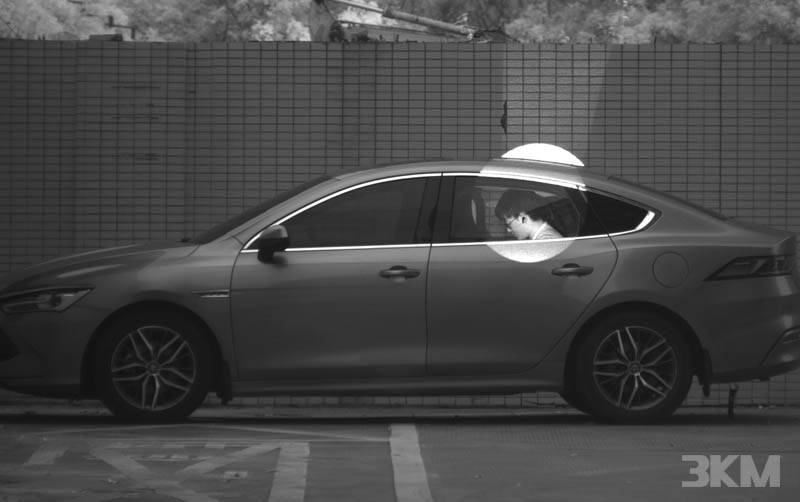
Successfully Penetrated Side Rear Window (Dark Heat-Rejection Film); Interior Details Clearly Visible
V. Solution: Full-Color Camera (Black-and-White Mode) + 808nm Infrared Laser Illuminator + Dual Filters
Based on the above approach, we propose a complete solution:
Full-color camera (black-and-white mode) + 808nm infrared laser illuminator + dual filters (±40nm)
The core logic of this solution is: use 808nm, the "film weakness band," as the penetration window; use black-and-white mode to maximize imaging clarity; use dual filters to suppress reflected light interference.
5.1 Why 808nm?
808nm happens to sit in a "vacuum zone" of film defense. It is below 900nm, avoiding the main absorption range of nano-ceramic film (900–1100nm); it is also below the long-wave infrared region where magnetron-sputtered metal film has its highest reflectance. At the same time, it is close enough to visible light to "borrow passage" through the visible light transmittance requirements for front windshields and side windows.
Actual tests show that 760–850nm light can more freely penetrate car window film, reach targets inside the vehicle, reflect back, and be received by the camera sensor.
5.2 Why Use a Full-Color Camera + Black-and-White Mode?
When a full-color camera switches to black-and-white mode, the IR-CUT filter is removed, and the sensor simultaneously senses visible light and infrared light. But the key is: in black-and-white mode, the camera does not need color interpolation.
In color mode, each pixel is composed of red, green, and blue sub-pixels, and the processor must perform complex color restoration and noise reduction calculations—a process that loses detail and sharpness. In black-and-white mode, the sensor directly outputs grayscale signals; each pixel is only responsible for recording "bright or not," making information more direct, and edges and textures appear clearer and sharper.
In low light, this advantage becomes even more obvious. Color mode either produces a very dark image or increases gain, causing noise to explode and the image to become smeared. Black-and-white mode with infrared illumination can greatly improve image brightness while maintaining clear details.
5.3 Why Use Dual Filters (±40nm)?
The dual filters only allow light within ±40nm of 808nm to pass, filtering out all other bands. This directly solves the "reflected light interference" pain point.
During the day, ambient stray light and reflections on the glass surface are blocked from the sensor by the filters, keeping the image clean. If a polarizer is added, it can further remove polarized reflected light from the glass surface, improving image contrast and clarity. At night, ambient light interference is naturally reduced, and only weak residual light and 808nm infrared light participate in imaging.
5.4 Specific Applications During Day and Night
Daytime application:
Use black-and-white mode, turn on the 808nm infrared laser illuminator, and use dual filters to remove ambient stray light and reflections on the glass. 760–850nm light more freely penetrates the window film, reaches targets inside the vehicle, reflects back to the camera, and directly outputs grayscale signals. The image is clear, sharp, and rich in detail.
Nighttime application:
Also use black-and-white mode and turn on the infrared laser illuminator. At this time, both visible light and infrared light can enter the sensor (IR-CUT removed). The 808nm infrared laser illuminator greatly improves image brightness, and with dual filters suppressing ambient light interference, the surveillance image can also clearly display details.
Whether day or night, this solution can stably output recognizable images of the vehicle interior.
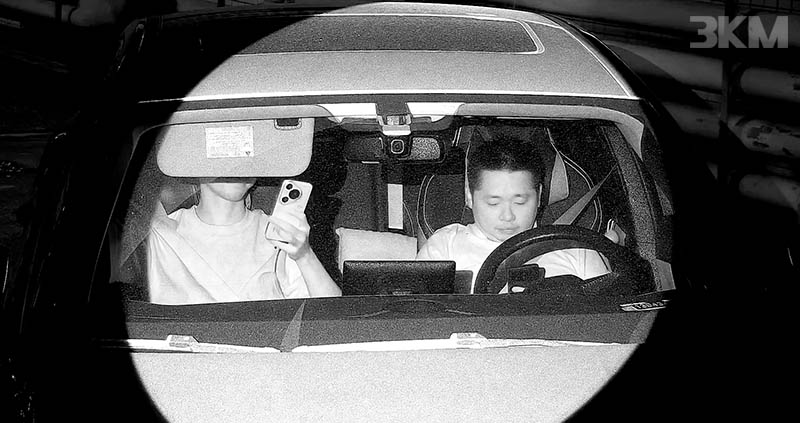
Nighttime Test Results Are Even Clearer
VI. Solution Benefits: One System Ends the "Blind Box"
6.1 Lower Cost
Compared with the high-end solution of "short-wave infrared camera + 1550nm infrared laser illuminator," this solution uses a conventional full-color camera (black-and-white mode) + 808nm infrared laser illuminator, significantly reducing hardware cost. The price of a 1550nm short-wave infrared camera and laser illuminator is far higher than that of an 808nm solution, while the effect is not necessarily better.
6.2 Clearer Image
Black-and-white mode has no color interpolation loss, so details are sharper; 808nm penetrates the film's weakness, so the signal is stronger; dual filters suppress reflected light interference, so the image is cleaner. Combined, imaging quality far exceeds traditional infrared solutions.
6.3 One System, Universally Applicable
This is the most revolutionary benefit. No longer need to prepare multiple sets of equipment for different films, no longer need to judge on site whether "this car can be photographed." One 808nm solution can effectively monitor through currently mainstream window films—whether dyed film, ordinary metal film, nano-ceramic film, or magnetron-sputtered metal film.
The era of "opening a blind box" is over.
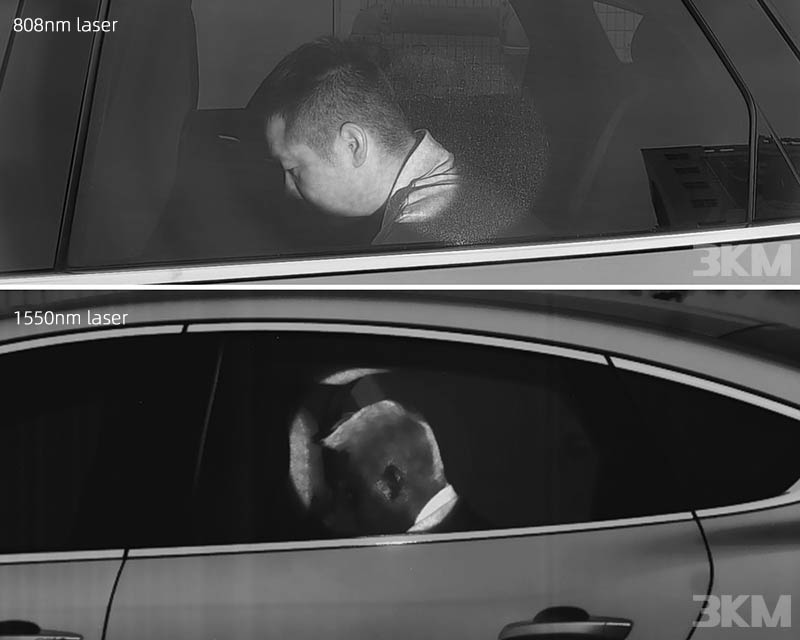
Comparison of the Effects of Two Solutions
VII. Conclusion: From Confrontation to Borrowing a Path—A Shift in Thinking Brings Global Optimum
The dilemma of infrared surveillance through car windows is essentially a dead cycle of "using infrared light against infrared protection." Window film rejects heat by reflecting infrared light; the stronger you are, the thicker it gets. There is no winner in this confrontation.
The real breakthrough comes from a counterintuitive turn: no longer fight head-on within the infrared band, but borrow the visible-near-infrared transition band that film cannot defend, and pass through the gap in the shield.
Together, the three form a solution that is lower in cost, clearer in effect, and universally applicable with one system. It does not seek to "crush" film on any single metric, but bypasses the film's defense logic to achieve global optimum.
For law enforcement agencies, this means: every surveillance operation is no longer an uncontrollable blind box.
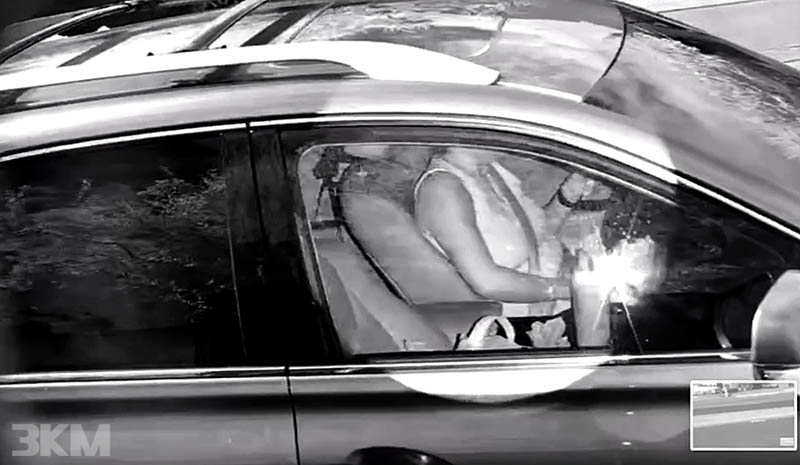
Foreign Client's Real-World Test of Vehicle-Mounted Infrared Through-Window Surveillance During Daytime Patrol—Moving Vehicles (Official Website Video)


