Product News
Index > NEWS > Product News
Why the "Slipper" Beats the "Missile" in UAV Night-Vision Surveillance
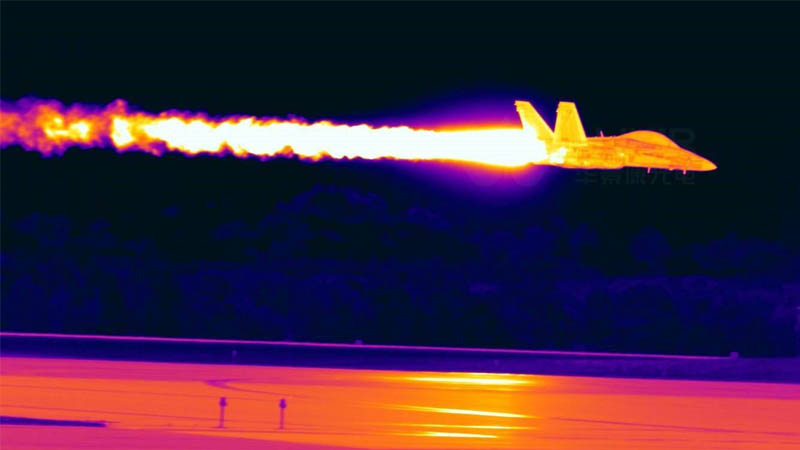
Why the "Slipper" Beats the "Missile" in UAV Night-Vision Surveillance
A Battlefield Data Beatdown That Overturns Conventional Wisdom
Seeing Clearly Is Worth More Than Detecting
The rules of engagement in UAV night-vision surveillance are quietly flipping.
For the past two decades, the industry held a deep-rooted belief: if you want night vision, you need thermal imaging. Thermal cameras passively detect heat, don't depend on ambient light, and can spot heat sources in total darkness. They're long-range, expensive, and sophisticated—like a costly "missile," with long reach and a fearsome reputation.
Then someone put a pair of "slippers" on the same battlefield as that "missile."
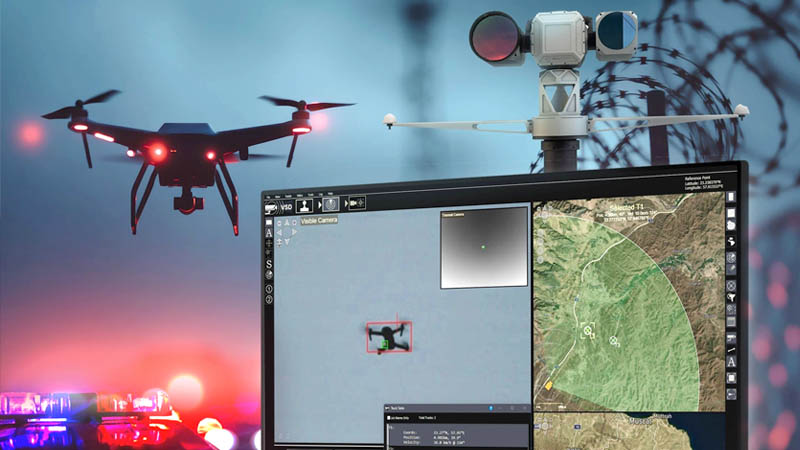
Infrared laser illumination is thumb-sized, weighs tens of grams, and costs hundreds of dollars—compared to thermal imaging, it's a pair of lightweight slippers.
By conventional logic, slippers shouldn't stand a chance against a missile. But in the specific battlefield of micro and light UAV night-vision surveillance, the "Slipper" is grinding the "Missile" into the ground. This isn't clickbait—it's real-world data from complex ground scenarios.
But this upset only makes sense if you understand what's really holding micro UAVs back.
Detection, recognition, tracking, and engagement—these are the four steps of UAV night-vision surveillance. Ideally, an airborne system should integrate multiple sensors working together: thermal imaging for long-range detection, infrared laser for close-in recognition. But the reality is harsh: the conflict between power consumption and payload is an unavoidable hurdle for UAVs. Micro and light UAVs—especially expendable platforms like FPVs—have tiny payloads and only minutes of endurance. The heavier and more power-hungry the equipment, the shorter the flight time. In real operations, these drones are often "one-shot" assets, where every gram and every dollar must count.
So the question becomes: between "detection" and "seeing clearly," which should a micro UAV prioritize? The answer is precisely where this reversal begins.
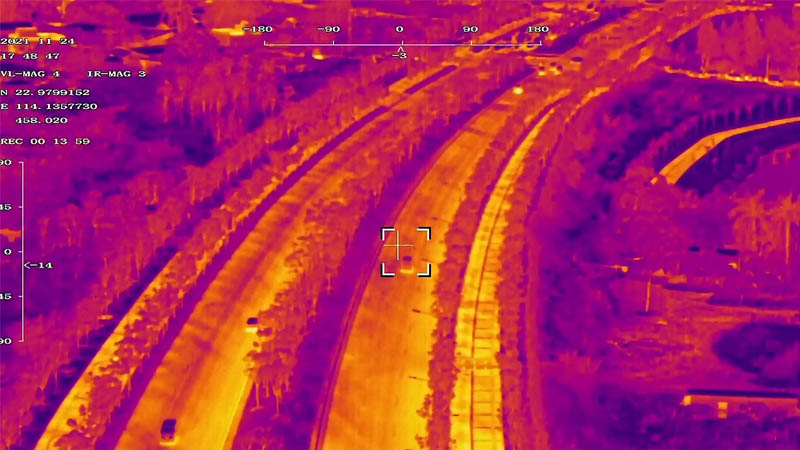
Chapter 1: The "Missile's" Three Dilemmas—Why Thermal Imaging Struggles on Micro UAVs
Don't dismiss thermal imaging too quickly. It has genuine strengths: passive imaging based on temperature differentials between target and environment. In wide-open "sky and sea" scenarios, it's king.
But UAV night vision rarely operates in such scenarios.
Dilemma One: "Heat source drowning" in complex ground environments.
You're patrolling over terrain—grass, factories, brick walls, parked cars. Everything the sun touched during the day radiates heat at night. How much temperature contrast does a person have against all that? The thermal image is a mottled map of heat blobs—a person drowns in environmental thermal noise, indistinguishable from a "hot rock."
Theoretical long-range detection often takes a big hit in real operations.
Dilemma Two: You can see it, but you can't tell what it is.
Micro UAVs almost universally use 640×512, 12μm uncooled cores, with only 25mm and 35mm fixed lenses as viable options.
Why? Longer focal lengths mean shorter recognition range; shorter focal lengths mean too narrow a field of view. High-resolution 1280×1024 cores are expensive, and their lenses are bulky and heavy, directly cutting into endurance—micro UAVs simply can't carry them.
So thermal imaging finds itself in an awkward position: 640×512 resolution, far below visible light; temperature-only imaging, no texture detail. A person 1.8m tall and 0.5m wide has a recognition range of only 200m with a 25mm lens, 250m with a 35mm. Even at those distances, all it can tell you is "there's a heat source here"—human, animal, or engine? Can't tell.
Worse still, it relies on digital zoom: digital zoom only interpolates and enlarges—it doesn't add effective pixels on target. The image blurs the moment you zoom in, blurrier the more you zoom. It cannot improve recognition.
Dilemma Three: Small targets and low-contrast objects—high miss rates, high false-alarm rates.
Once a person's temperature approaches the environment's, it can't pick you out; a rabbit or a warm motor can fool it into alerting. Night-shift security personnel are often exhausted by its "everything looks suspicious" behavior.
Degraded detection, short recognition range, missing texture, high false alarms, blurry when zoomed—this is the "Missile's" real battlefield record on micro UAVs. It's not bad; it's just mismatched to this battlefield.
Chapter 2: Why the "Slipper" Wins—The Underlying Logic of Infrared Laser
Now it's the "Slipper's" turn.
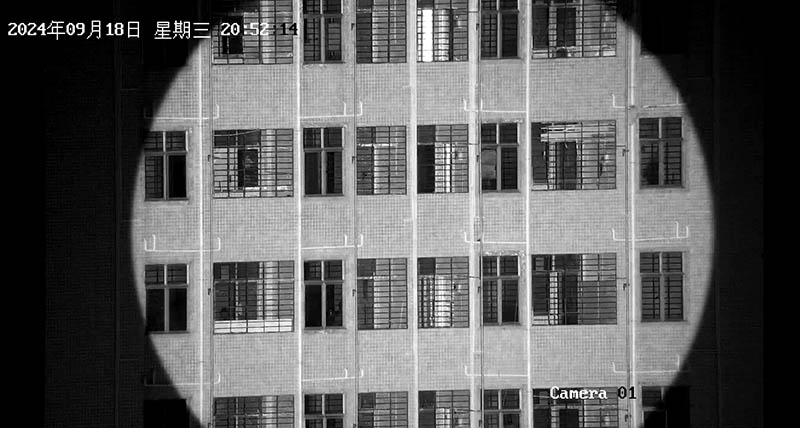
The working principle of infrared laser illumination boils down to one sentence: active illumination, reflective imaging. It emits an invisible near-infrared laser beam—like an "invisible searchlight"—at the target, and a low-light camera captures the reflected light to form an image. Wherever the light reaches, it can see clearly.
This isn't sophisticated technology; it's almost plain—and that plainness is exactly what gives it its edge.
Infrared laser illuminators used on micro UAVs are mostly 800m or 1000m class. Take the 65-gram, thumb-sized 800m laser illuminator: it doesn't care about core resolution—it simply "lights up" the visible-light camera, letting it "open its eyes" at night. And that changes everything:
Visible-light cameras have smaller pixels and higher resolution (easily supporting 1920×1080 Full HD and 3840×2160 4K UHD imaging);
Longer focal length narrows the field of view, making the target larger in frame with more detail;
In total darkness, it delivers visible-light-grade detail—you can recognize faces and read license plates.
In other words, thermal imaging gives you a "heat blob"; infrared laser gives you a "picture." One tells you "someone's there"; the other tells you "who it is."
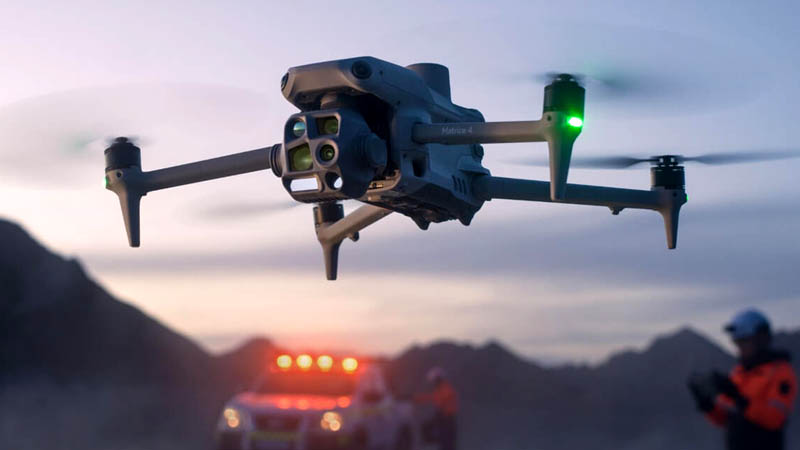
Chapter 3: Six-Dimension Showdown—A Data Beatdown With No Mercy
Talk is cheap. Let's look at the data.
Showdown 1: Range—3–5× Tracking Gap, Recognition Range Beats Detection Range
First, tracking. Following the same person:
Visible light at 25mm focal length: tracking range ~1,250m;
Thermal at 25mm: only ~268m;
A gap of nearly 5×.
Even with a 35mm thermal lens, it's only 365m—still a 3.5× gap. Why such a difference? Because the pixel-size gap is physical. Illumination merely lets visible light "unleash" the advantage it was always meant to have—while thermal is inherently limited by its 12μm pixels.
Now look at "seeing clearly" range:
Infrared laser can see clearly, recognize, and track targets at 800m;
At 12° beam angle: clear recognition at 700m, spot diameter 146m;
At 17° beam angle: clear recognition at 640m, spot diameter 192m.
And thermal's recognition range? 200m at 25mm, 250m at 35mm.
The dagger: thermal's "detection range" is shorter than infrared laser's "clear recognition range." You're still in the "detection" phase; the other guy has already recognized the face.
Showdown 2: Field of View—One Lights a Strip, the Other Lights a Field
Thermal fixed lenses on micro UAVs have limited coverage:
25mm: FOV 17.4°×14°, coverage 60m wide × 42m high;
35mm: FOV 12.5°×10°, coverage 44m wide × 35m high.
Infrared laser spot:
At 200m: spot diameter 224m, illumination angle 56°;
At 250m: spot diameter 254m, illumination angle 54°;
At 700m: spot diameter 146m, illumination angle 12°.
One is a narrow slit; the other is a broad illuminated field. The area infrared laser illuminates in one pass is dozens of times thermal's FOV. Search efficiency and target coverage aren't even in the same league.
Showdown 3: Image Quality—"Detected but Unclear" vs. "Detected and Recognized"
Thermal clarity depends on NETD and resolution. With 640×512, when target temperature approaches ambient, it can't even tell "human from dog," let alone confirm identity.
Infrared laser? Visible-light-grade detail in total darkness, supporting Full HD and 4K UHD imaging; in extreme low light, active illumination reaches 3× the range of passive imaging. Texture capture, facial recognition, license plate reading—it directly fixes thermal's biggest weakness: "detected but unclear."
That 3× is especially critical for small targets. You're not looking for a tank—you're looking for a person hiding in a corner.
Showdown 4: Weight—The Lighter One Flies Longer
Payload is a UAV's lifeline.
Thermal core: 38g; with 25mm fixed lens: 65g; total 90g, dimensions 28×28×58mm;
With 35mm lens: 145g, dimensions 44×44×69mm;
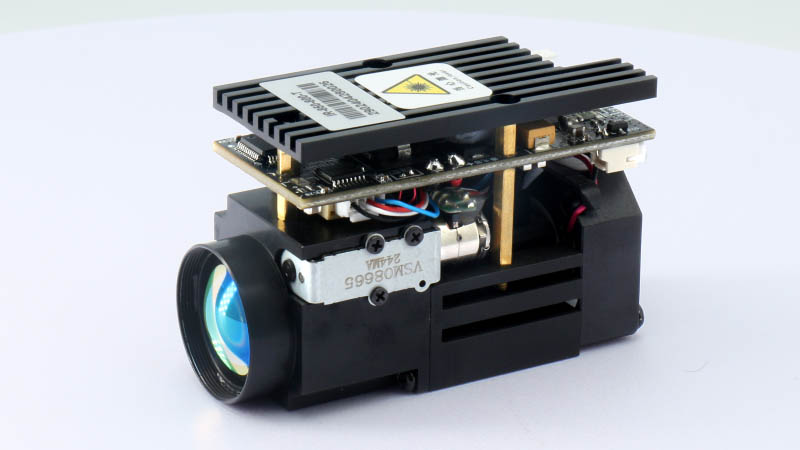
Sanqianmi Optoelectronics' 800m micro infrared laser illuminator: only 65g, dimensions 27×40×64mm;
With clever use of UAV air cooling, it can drop to 26g, dimensions 27×29×37mm.
The infrared laser illuminator is lighter and smaller. Those tens to hundreds of grams saved translate into longer endurance, longer loiter time, more mission time. In the field, one more minute of flight can be the difference between life and death.
Showdown 5: Stealth—The "Missile's" Advantage, Dismantled by the UAV Itself
Granted: thermal imaging is stealthier. It's purely passive—emits nothing, naturally covert.
But that advantage is destroyed by the drone's propellers.
A light FPV (5-inch standard racing quad) hits 80–90dB at 1 meter; in open, unobstructed night conditions, human ears can pick up drone noise within 300m. In other words, beyond thermal's recognition and tracking range, human ears have already heard the drone. The "high stealth" never gets a chance to matter—the target is already alert.
As for infrared laser's red glow—yes, there's a faint red glow at the emitter, detectable by other night-vision devices within the illumination angle. But note: outside the illumination angle, the probability of detection drops significantly. Compared to 80–90dB of prop noise, that tiny red glow is negligible.
Showdown 6: Cost—Slipper Price, Missile Performance
Thermal imaging costs 3–10× more than infrared laser illumination. For expendable FPVs and mass-deployed micro UAVs, that gap is fatal. The money for 10 thermal setups buys 30–100 infrared laser setups. Slipper price, missile performance—that's how a war of attrition should be fought.
Chapter 4: The Solution—Why the 800m Micro Laser Illuminator Delivers
After the six-dimension showdown, the answer is clear. But a good solution isn't just "strong"—it must be affordable, covering, and carryable.
The 3KM Optoelectronics' 800m micro infrared laser illuminator is built for the micro UAV battlefield:
Thumb-sized, starting at 65g: 27×40×64mm, barely占用 payload; with onboard air cooling, down to 26g and 37mm length.
800m clear recognition: sees clearly, recognizes, and tracks targets at 800m; 12° beam angle for 700m recognition, 17° for 640m, spot coverage 146–192m.
Active illumination, 3× night range: in extreme low light, reaches 3× the range of passive imaging—built for small targets.
Full HD detail: with low-light cameras, outputs 1080P/4K visible-light-grade imagery—faces, plates, textures crystal clear.
Light, small, cheap: lighter, smaller, and 3–10× cheaper than thermal.
It solves not the "can I see at night" problem, but the "how does a micro UAV truly see clearly under payload, endurance, and cost constraints" problem.
Tangible benefits:
1. Longer endurance: saved payload becomes longer loiter and wider patrol radius;
2. Sharper recognition: from "seeing a heat source" to "seeing who it is"—false alarms drop sharply;
3. Multiplied search efficiency: one pass lights up a field—coverage dozens of times thermal's FOV;
4. Cliff-edge cost reduction: mass deployment becomes feasible; expendable operations no longer hurt;
5. Combat-ready: 800m clear recognition beats thermal's detection range—while thermal is still trying to "recognize," infrared laser has already "seen clearly."
Conclusion: This Battle Is Won by "Clarity"
Back to the original question: for micro UAV night vision, should you prioritize "detection" or "seeing clearly"?
Thermal's answer is "detection"—but in complex ground scenarios, its detection is degraded, its recognition is short-legged, and it's prohibitively expensive.
Infrared laser's answer is "seeing clearly"—at minimal cost, it achieves "clear recognition" at ranges thermal's "detection" can't even reach.
On the micro and light UAV battlefield, a "slipper" beats a "missile" not because it's smarter, but because it's more clear-headed: it knows it can't fly far, carry much, or spend big—so it pours every gram and every dollar into "seeing the target clearly."
Seeing clearly is worth more than detecting. This isn't a slogan—it's the plainest, sharpest core of this night-vision revolution.
The standard for selection is never "who's stronger," but "who's more suited to this battlefield." When a pair of slippers can take you down, it's time to reconsider whether that missile is really worth carrying on your back.
Author's note: This article addresses only micro, expendable UAV night-vision scenarios. It does not dismiss thermal imaging. In medium/large UAVs, long-range wide-area search, and night search-and-rescue, thermal imaging—with its rapid detection and accurate positioning—remains an unquestioned and irreplaceable king. Thermal is a fine "missile"; it's just that on the micro UAV battlefield, it's outmatched by infrared laser illumination.


