Product News
Index > NEWS > Product News
Infrared Laser Illumination for River & Coastal Defense Night Surveillance: Selection & Field Guide
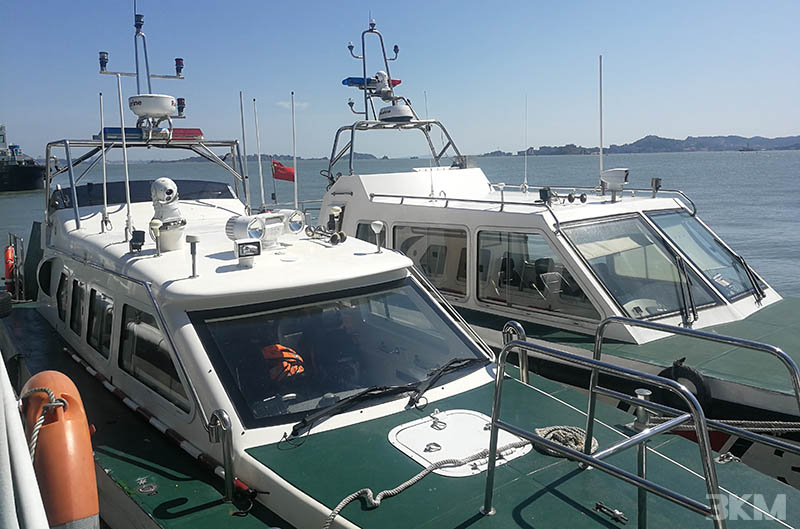
Infrared Laser Illumination for River & Coastal Defense Night Surveillance: Selection & Field Guide
River and coastal defense surveillance is shifting from "seeing" to "seeing clearly and identifying accurately." Thermal imaging handles wide-area detection, radar penetrates rain and fog for search, and AI performs integrated recognition—but what ultimately determines whether you can read a hull number, identify a person, or secure evidence at distances of several kilometers is often the overlooked link: infrared laser illumination.
This guide breaks down the five common wavelengths—808, 850, 940, 980, and 1550nm—from a field perspective to help you find the one that best fits your scenario.
1. Why Coastal Defense Night Surveillance Depends on Infrared Laser Illumination
The mainstream architecture for modern river management and coastal defense surveillance is a multispectral combination of "visible light + thermal imaging + infrared laser illumination + radar + AI recognition." The division of labor is clear:
Thermal imaging and radar detect targets at long range in darkness, including identifying camouflage;
Infrared laser illumination captures fine detail and texture for evidence after detection;
AI recognition links to determine target nature and reduce manual monitoring burden.
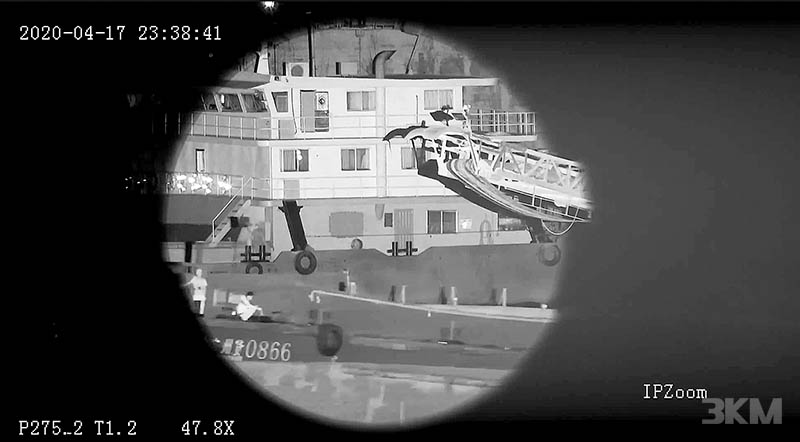
Coastal defense lines are long and environments complex. The core requirement is "long-range detection, clear viewing, and identification," achieving continuous day-and-night monitoring without difference. The value of infrared laser illumination lies here: in complete darkness, it enables cameras to see details at distances of several kilometers; compared with thermal imaging and radar, the technical cost is lower; and the imaging results can be directly fed to AI recognition systems for linked use.
It is not a search tool but a confirmation and evidence-gathering tool—this determines the selection logic.
2. Five Wavelengths, Five Dimensions: How to Compare
Common infrared laser wavelengths in security night surveillance are 808, 850, 940, 980, and 1550nm. At the same output power, effective distance varies by wavelength, but the root of the difference lies not only in the wavelength itself but in whether that wavelength falls within the sensitivity range of the camera's CMOS sensor. Discussing wavelength and performance apart from the camera is meaningless.
We compare across five dimensions most relevant to field operations.
2.1 Effective Distance and Fog Penetration: Shorter Wavelengths Win in Clear Weather, Longer Wavelengths Rule in Water Fog
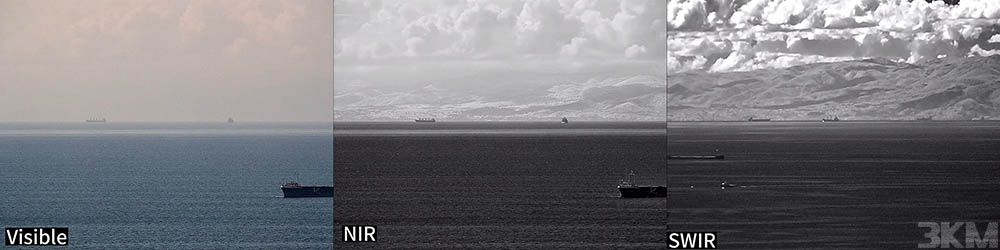
Extensive field applications show that, at the same output power and beam angle under good air conditions, with each matched to its appropriate camera, shorter wavelengths actually perform better—808nm outperforms 850, 940, 980, and 1550nm in effective distance.
But the sea surface is not a laboratory. When water fog is present, scattering causes rapid beam energy decline, and the shorter the wavelength, the stronger the scattering. Therefore, 1550nm has notably stronger fog penetration than 808nm and other shorter wavelengths, performing better and reaching farther in foggy weather. Note, however: the fog-penetration gap between 808 and other shorter wavelengths is not significant—the real watershed is 1550nm.
Field takeaway: In inland waterways with light fog and mostly clear nights, the distance advantage of shorter wavelengths can be fully utilized; in coastal defense with frequent sea fog, the fog-penetration value of 1550nm truly pays off.
2.2 Covertness: Red Glow Is the Watershed
Infrared laser light is invisible to the naked eye, but shorter-wavelength laser illuminators typically show a small visible red dot at the aperture, known in the industry as red glow. This is a normal physical phenomenon of near-infrared lasers, not an equipment fault.
Red glow intensity relates to wavelength, viewing angle, and viewing distance: the closer the viewing angle to the beam axis, the more obvious the red glow; the greater the viewing distance, the weaker the red glow; the shorter the wavelength, the more obvious the red glow. 808, 850, 940, and 980nm all exhibit visible red glow, differing only in intensity. 1550nm has no red glow at all—even conventional infrared detection equipment cannot detect it.
Field takeaway: Civil defense scenarios have low covertness requirements, and red glow is acceptable; for coastal defense where monitoring positions must not be compromised, 1550nm's "silent illumination" is irreplaceable.
2.3 Equipment Cost: A Tenfold Gap, Widening with Distance
808, 850, 940, and 980nm are mainstream on the market, with little price difference between lasers and matched cameras. But 1550nm lasers and short-wave cameras can differ by about ten times in price, and the gap widens with effective distance. The reason is that 1550nm is forced out of the inexpensive silicon/GaAs system into the InP/InGaAs material system—this cost is essentially paying for "eye safety," "fog-transmission advantage," and "covertness."
Field takeaway: For cost-sensitive projects, shorter wavelengths are the rational choice; 1550nm should be used where it counts, not deployed across the board.
2.4 Safety: Look Beyond Wavelength to Optical Energy Density
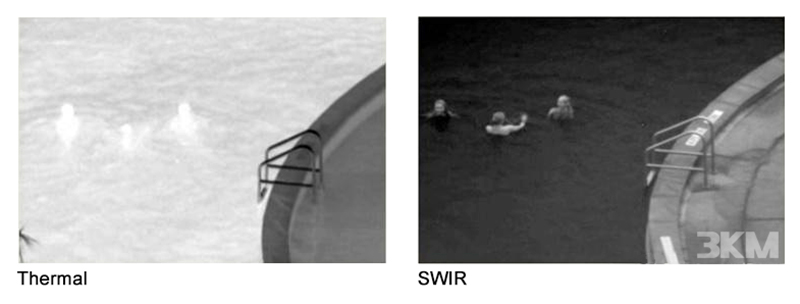
Wavelength safety does not equal product safety: 1550nm laser light is largely absorbed by the water in the cornea and lens, barely reaching the retina, and is regarded as an "eye-safe" wavelength; high-power 808nm, if accidentally directed into the eye, may cause irreversible damage. But this is only analysis at the wavelength level and cannot be directly equated with actual risk—output power, beam angle, irradiation intensity, and exposure time are all non-negligible risk variables.
Regardless of wavelength, lasers with effective ranges of hundreds of meters to several kilometers have output powers from several watts to over a hundred watts, far exceeding the milliwatt-level maximum permissible exposure for the human eye. Safety is the primary design challenge for infrared lasers, and the solution lies in optical energy density. Take an 808nm laser with a 2km effective illumination range (12W output) as an example:
At 2km, with a 0.8° beam angle, the irradiance within the spot is about 1,000 times lower than the Class 1 laser safety limit, with an eye-safe distance of 69 meters;
At 300m, with a 61° beam angle, the irradiance within the spot is more than 10,000 times lower than the Class 1 laser safety limit, with an eye-safe distance of less than 1 meter.
Only by layering software and hardware fail-safe designs can eye safety be systematically ensured.
Field takeaway: Don't be misled by the single phrase "1550nm is eye-safe," nor reject 808nm because it carries risk. Look at overall design, spot energy distribution, and safety protection mechanisms—that is the professional approach to selection.
2.5 Clarity: Matching Matters More Than Parameters
Image clarity seems the most complex but is logically the simplest: ensure the laser wavelength matches the camera's CMOS sensitivity range, and that illumination intensity and beam angle meet scenario requirements, and optimal results follow. On this basis, laser spot homogenization, synchronous zoom, and full-range clarity technologies determine the ultimate ceiling of image quality.
Field takeaway: First select the right wavelength-camera combination, then discuss optical processing technologies. Get the match wrong, and no parameter sheet will save you.
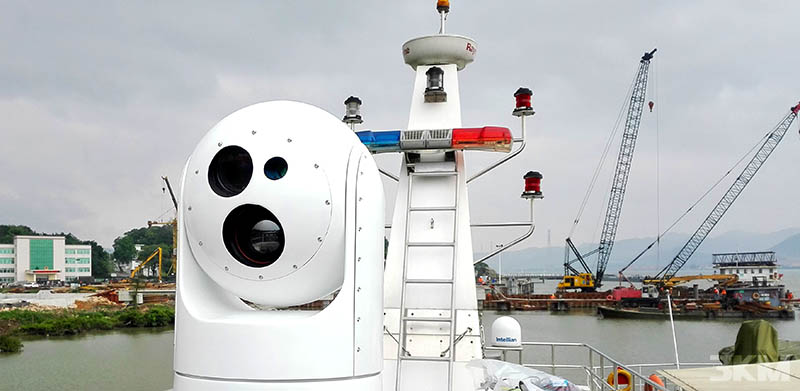
3. Solution Recommendations: Two Routes for Civil Defense and Coastal Defense
River and coastal defense night surveillance falls roughly into two categories, with fundamentally different selection logic:
Civil defense scenarios (river civil defense, inland waterways, port areas, bridge areas, anti-poaching and anti-sand-mining)—cost-sensitive, with relatively relaxed covertness requirements. 808nm infrared lasers are the pragmatic choice: low cost, best effective distance in clear conditions, and red glow acceptable in civil defense. Fog penetration is inferior to 1550nm, but in inland rivers spanning kilometers, fog is usually not a major obstacle.
Coastal defense scenarios (border coastlines, boundary rivers, islands and reefs, anti-smuggling, ports of entry, sensitive waters)—greater emphasis on covertness and fog penetration. 1550nm infrared lasers are the targeted answer: no red glow, strong covertness, outstanding fog penetration in water fog, suitable for defense lines that must avoid revealing monitoring positions and face frequent sea fog over broad areas. The cost is about ten times higher, so they are better deployed at key points, forming a tiered configuration with shorter-wavelength equipment.
As for 850, 940, and 980nm, they need not be the first choice for new projects—unless existing cameras happen to match that band, in which case direct matching suffices. Their home ground is compatible replacement in legacy systems, not the core choice for new solutions.

Conclusion
The role of infrared laser illumination in coastal defense night surveillance can be summed up in one sentence: thermal imaging and radar "find," infrared laser "sees clearly," and AI "assesses." The essence of selection is finding the best balance among effective distance, fog penetration, covertness, safety, and cost for your scenario.
Shorter wavelengths win in clear weather; longer wavelengths rule in water fog. Civil defense prioritizes cost; coastal defense prioritizes covertness and fog penetration. There is no universal wavelength—only solutions honest to the scenario.


